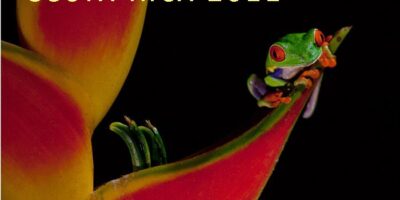
Costa Rica 2011 The Art of Biodiversity – Part 4

Bosque de Paz Ecolodge

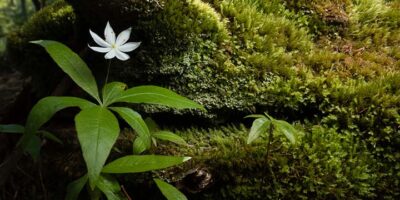
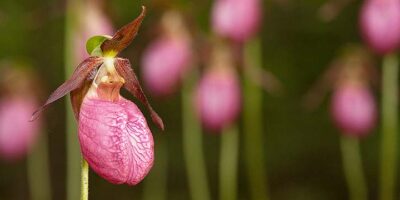
This small lodge, located in a valley between the Poas Volcano and Juan Castro Blanco National Parks offers a diversity of subjects to photograph. The owners, Federico and Vanessa González-Pinto are working hard, and succeeding in, developing an ecological corridor linking the two nationally protected areas.  They are amiable hosts and are truly concerned for the nature of Costa Rica.  In addition to the variety of landscape opportunities of the cloud forest moss-covered trees and rushing streams, the place is teeming with hummingbirds.  There is also an extensive collection of orchids located near the main building that hosts hundreds of orchids, and the owners sponsor orchid research supporting preservation efforts.  On the afternoon of our arrival, I spent some time photographing in the forest, and captured a few images of hummingbirds hovering near the feeders.  The first orchid in the series is a stacked focus images, made from six images that have different zones in focus.  I’ll be writing a blog post on the technique soon.

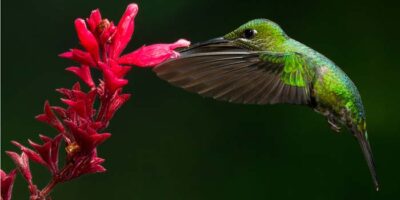
In addition to the local photographic opportunities, two setups for high speed flash photography were made available on the second day of our stay here and a schedule for use by the participants was established.  Initially we set up hummingbird feeders to attract the hummers to the sets, but switched to flowers after the first round.  While high speed flash set ups make photographing crisp images of hummingbirds possible, it’s difficult to predict exactly what the image will look like until you view the image.  It’s a simple matter to take a photo of the hummingbird with its beak in the flower since it stays there for a few seconds, although you never know what the position of the wings will be.  It’s much more challenging to catch the hummingbird approaching or departing from the flower, or if there is an altercation with another hummingbird. On several occassions the birds were landing on flower pants and breaking them off, making for a not-so-attractive flower.  I walked over to coax a Green-crowned Brilliant off a flower and it stepped onto my finger where it stayed for a full minute.  Luckily, I still held on to the wireless remote control and was able to capture some images.

On the third day of our stay at Bosque de Paz, we made a day trip to a nearby restaurant that has access to the 110 meter Bajos de Toros waterfall.  There are trails through the forest and a set of stairs that descend to the base of the falls.  Two hummingbird high speed flash setups were placed in the open air restaurant to take advantage of some species which were not found at Bosque to Paz.  This was the first time I had seen a black-bellied hummingbird, a very small bird that fluffs the feathers on its head in a curious way when it is perched.  When it is flying, the feathers are flattened aerodynamically.

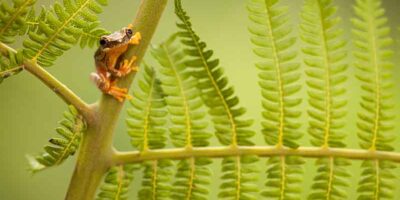
After dinner at Bosque de Paz, a few of us ventured out around the lodge and down a path to find insects and frogs for some nighttime macro photography.  We did find a small tree frog which was about ¾ of an inch in length, and we had great opportunities with a cicada which had just climbed out of its shell and was still damp and unable to fly.  We all had our turn photographing this amazing insect by flashlight.

Costa Rica 2011 The Art of Biodiversity – Part 3

Arenal Observatory Lodge 

Arenal is the country’s most active volcano, with continuous emissions of lava and incandescent pyroclastic flows since the beginning of the present active cycle in 1968.  In 2010 when I visited this location, the eruptions could be heard day and night roaring, coughing and spitting, but due to the low cloud cover, not seen. I did get a view of the pyroclastic flows through a break in the clouds for about 30 seconds one evening. The weather did cooperate this year with clear skies one evening and clear skies one morning during sunrise.  Unfortunately, the volcano stopped erupting to a great extent three months prior to our visit.  It was quiet. You could still see steam coming from several vents in two locations near the summit, but no fireworks.  The lodge grounds offer many gardens, and there was an extensive garden right outside our room where we could observe hummingbirds feeding at the flowers.

We spent one day at a nearby facility that houses a wonderful collection of frogs, toads, snakes, and lizards. The staff set up several stages with natural vegetation, moss covered rocks and stumps; the vegetation on the nearby hills provided out of focus backgrounds, and we could photograph with natural light or with fill flash as we chose.  It was a great opportunity to photograph species which would be difficult, if not dangerous, to photograph in the wild.  The facility also had a butterfly enclosure which I visited while waiting for the set ups to be ready.  Once the stages were completed, several species were brought out and placed in the setup.  An experienced caretaker stayed with the animal at each set up, repositioning the subject when it moved into a position that was not photographic.  The caretaker would replace the animal when it appeared to be too active, or when photographic interest in that subject diminished.  At the end of the day, one caretaker asked my wife Chris if she wanted to hold the Rainbow Python, which she did.  She was surprised that it was very soft to the touch.

We also spent a morning at the Danaus Ecocenter.  There was a limited number of birds in the area due to the time of year, but quality is often better than quantity.  We had quite a long time with several Collared Aracaris feeding on fruit very close to the path.  And one of the guides showed us the location of a baby three-toed sloth since it was not on one of the main paths, but on a service road.

All in all, Arenal Observatory Lodge is one of those locations in Costa Rica which could easily support a week’s worth of photographic subjects, if you know where to look.  There are trails up through the forest to the lava fields and a large lake that we didn’t explore on this trip.  However, unless you were on a Foto Verde guided trip, you wouldn’t have the opportunity to photograph the variety of reptiles that I did on this trip.


Costa Rica 2011 The Art of Biodiversity – Part 4


Costa Rica 2011 The Art of Biodiversity Part I

Chris and I traveled recently to Costa Rica with my friend and tour leader, Greg Basco, cofounder of Foto Verde Tours, a provider of tours designed for photographers. Last year I traveled to Costa Rica with Joe and Maryann McDonald primarily to photograph hummingbirds, and met Greg who organized and co-led the trip. This year I signed up early for the Art of Biodiversity tour which offered a wider variety of photographic subjects at the start of the rainy season. Chris decided to join me at a later date, which worked out well as there were only two other participants for a total of four plus Greg and Jose Lopez, our driver and also a very good photographer.

My blog entries for this trip will be divided by location, starting with the Bougainvillea Hotel in Heredia, near San Jose, the capital of Costa Rica. We also traveled to Selve Verde Lodge, the Arenal Observatory Lodge, and the Bosque de Paz Ecolodge as well as side trips from those locations.

Don’t want to miss any posts? Sign up for an automatic email letting you know when I’ve posted something new using the widget on the right side panel.

The Bougainvillea Hotel This was my third trip to Costa Rica and each time I stayed at the Bougainvillea to start and end each trip. Tour providers choose this hotel in a residential area for its 10+ acres of gardens that include over 50 species of bromeliads, native trees, orchids and frog ponds. Each visit offered different plants in blossom. And while my two visits in March had quite a few birds in the garden, in June the migratory birds were gone, and the local birds were raising chicks and mostly staying hidden. There were more plants in blossom, but fewer orchids. In any case, I wasn’t disappointed with the opportunities to use my macro lens.


Costa Rica 2011 The Art of Biodiversity – Part 2


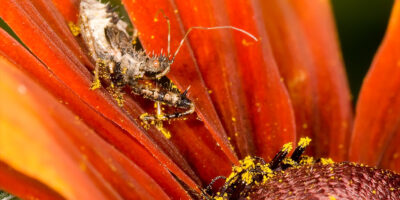
Bee Assassin

This Bee Assassin stayed on one of two flowers during a four week period in September.  The first images are in the nymph stage, and gradually transformed into the adult form over the first two weeks.  I visited the flower often to see if the bug would catch something to eat. Near the end of the fourth week I was fortunate to see, and photograph,  the insect eating a bee.

 Assassin bugs get their name from the way they attack their victims, inflicting sharp stabs with their beak.  Their front most legs have powerful muscles to grab and hold their prey while the body fluids are sucked out. The bug pounces on bees and other pollinating insects. After grabbing the prey, the insect thrusts its cutting beak in to the victim’s back, injects an immobilizing digestive agent, then sucks out the body juices.

 For these images I used a Canon 40D camera with a Sigma 150mm macro lens and a Canon MT-24EX twin light.

Jan and Cemal’s Yard

My friends, Jan and Cemal, have the nicest house with wonderful flower beds both in front yard and back yard.  And no grass to cut.  I’m envious.  They invited Chris and me for a barbecue as well as to photograph the flowers that were at peak blossom.  Except for the fact that it was getting dark and I had to quit, I had a great time.  These images are the result.  They were all taken using a Canon 40D camera with a Sigma 150mm macro lens.

Newport Flower Show

The Newport Flower Show is an annual event of the Newport Horticultural Society held at Rosecliff, one of Newport’s mansions. Held this year on June 26-28, it included two butterfly “houses”, tents really, that featured native butterflies that were to be released at the end of teh show.  Floral arrangements were submitted according to guidelines and the combinations of flowers and greenery is amazing.  Local gardeners display their efforts as cuttings of single blossoms or leaves, as well as entire plants.  The show included a photography competition open to both amateur adn professional photographers.

Photographing inside the exhibition was frustrating in that there were so many people there, even though I went the first day at the opening time.  Macro photography is the best choice as tripods are not allowed, you can get close to the subjects, and using flash can light up areas within blossoms even while hand holding the camera.

Watch for next year’s flower show scheduled for 25-27 June 2010.

Kauai, the Garden Island, in the Garden

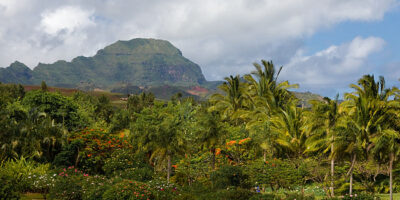
I stayed at the Sheraton Poipu Beach on Kauai.  The hotel has magnificent landscaping with ponds and plantings, and a nearby orchid and succulent garden.  These images were made in those gardens and around the hotel.  The last three images are of the same flower, with some artistic image editing.

Kauai, the Garden Island, in the Wild

While in in the Kokee State Park, where Waimea Canyon is located, I found many wildflowers growing along the side of the road.  All of these images were made on one drive through the park.  The snail was photographed on the lawn of the hotel; it was eating fallen blossoms of a plumeria tree.